
- Panyu District, Guangzhou, Guangdong, China
- 2044, 2nd Floor, Yayun Avenue, Dalong Street
- whatsapp:
- +86 13265357928
Innovative Practices and Applications of Web SPC Systems
In the field of quality management, traditional Statistical Process Control (SPC) often faces the dual challenges of "data silos" and "analysis lag." With the deepening of industrial digitalization, we believe that SPC should not be merely a drawing tool, but rather a real-time pulse connecting the production site and management decisions.
1. Real-time: Bridging the time lag between data and analysis
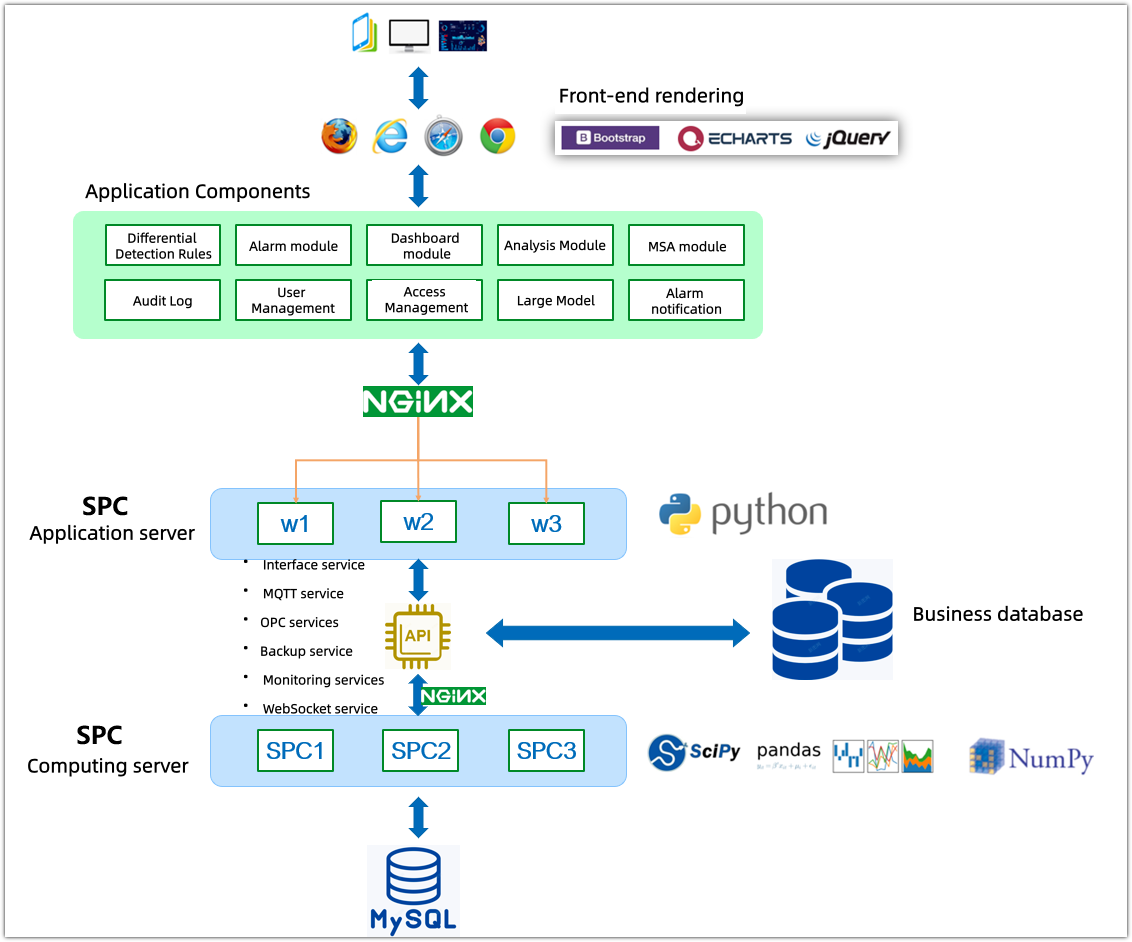
The system adopts a B/S architecture, achieving seamless integration from data generation to chart feedback. Through integrated HTTP, MQTT, TCP, OPC, and other interface protocols, data from sensors or detection equipment on the production line can be synchronized to the system in real time. This mechanism ensures that control charts are updated automatically without manual refresh when the page is open, truly transforming quality control from "post-event statistics" to "process prevention."
2. Multi-dimensional dashboards: Building a comprehensive monitoring view
To meet the quality management needs at different levels, we have designed three types of core monitoring dashboards, supporting the creation of an unlimited number of display pages:
• Dynamic Dashboard: Designed specifically for production workstations, it is projected onto the workshop's large screen via an independent URL. Data changes in real time as it flows in from the inspection points, allowing frontline personnel to immediately grasp the stability of the process.
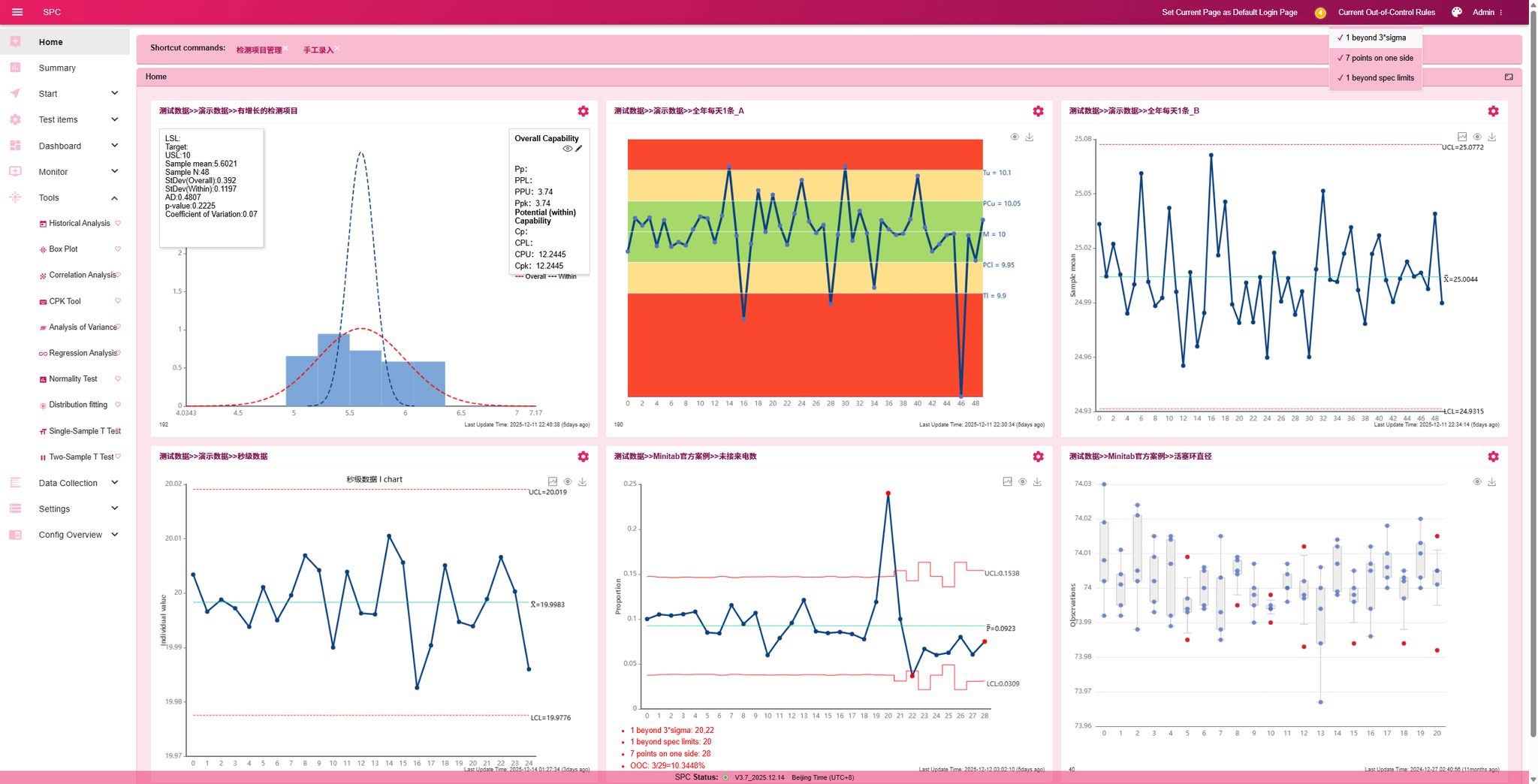
• Integrated Dashboard: Supports cross-process configuration, allowing control charts, rainbow charts, or histograms of different testing items to be freely combined in the same view, enabling centralized monitoring of complex processes.

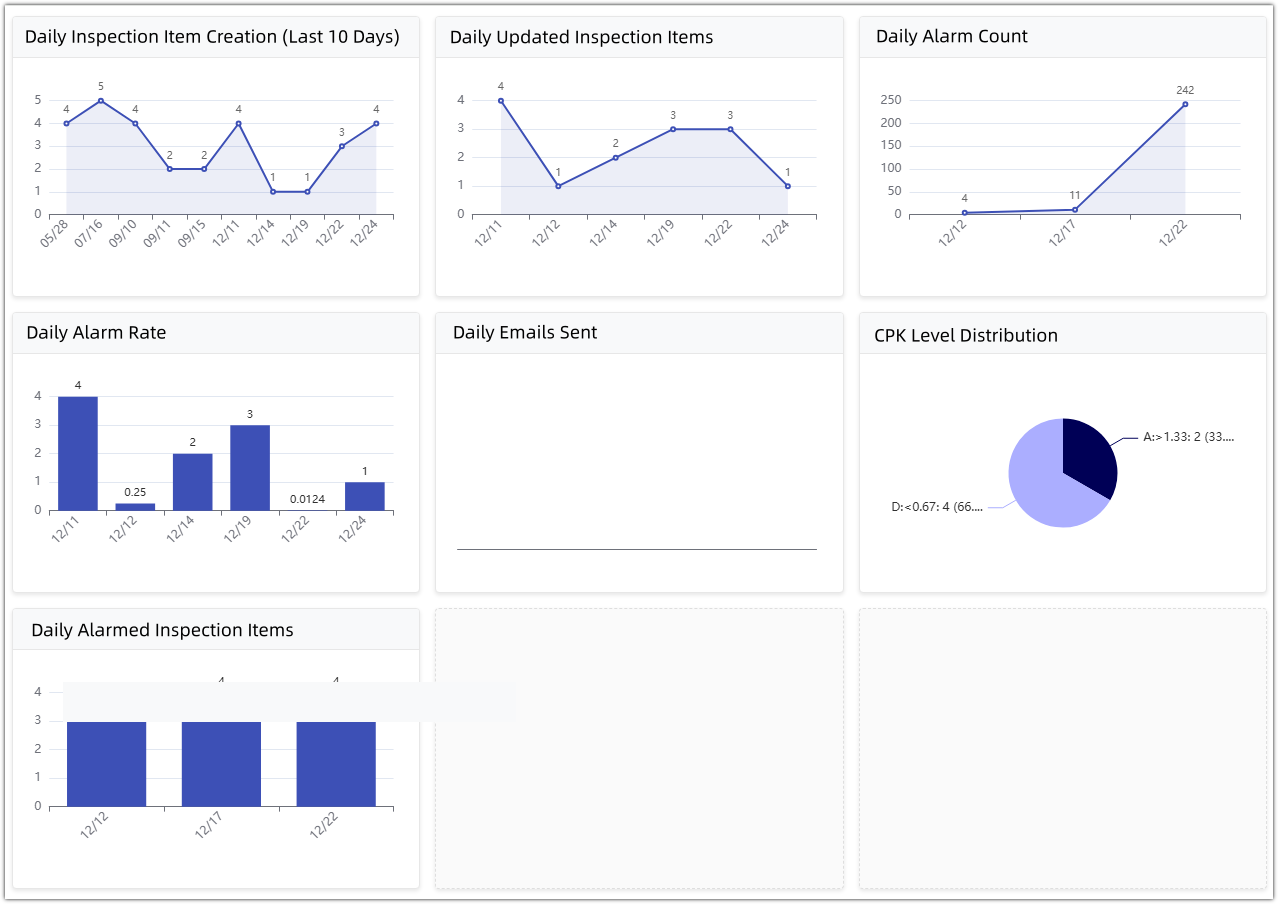
• Statistical Dashboard: Provides data summaries for management, intuitively displaying daily alarm rates, number of updated detection items, and anomaly lists, identifying systemic quality risks from a global perspective.
3. Closed-loop alarm: From anomaly detection to improvement record
A robust backend monitoring service is the core of the system's proactive defense. Its key feature lies in the independent configuration of anomaly detection rules and alerting rules:
• Omnichannel reach: The backend monitors SPC anomaly detection and CPK/PPK process capability alerts in real time. Once a rule is triggered, the system can immediately push alarm information via email, WeChat Work, DingTalk, Lark, and MQTT interface.

• Closed-loop management: Personnel receiving alarms can directly register improvement measures in the system. This closed-loop model, from anomaly detection and message push to the recording of processing results, ensures that nursing measures are traceable and that the improvement process is clear and transparent.
4. In-depth technological development: AI empowerment and reliability assurance
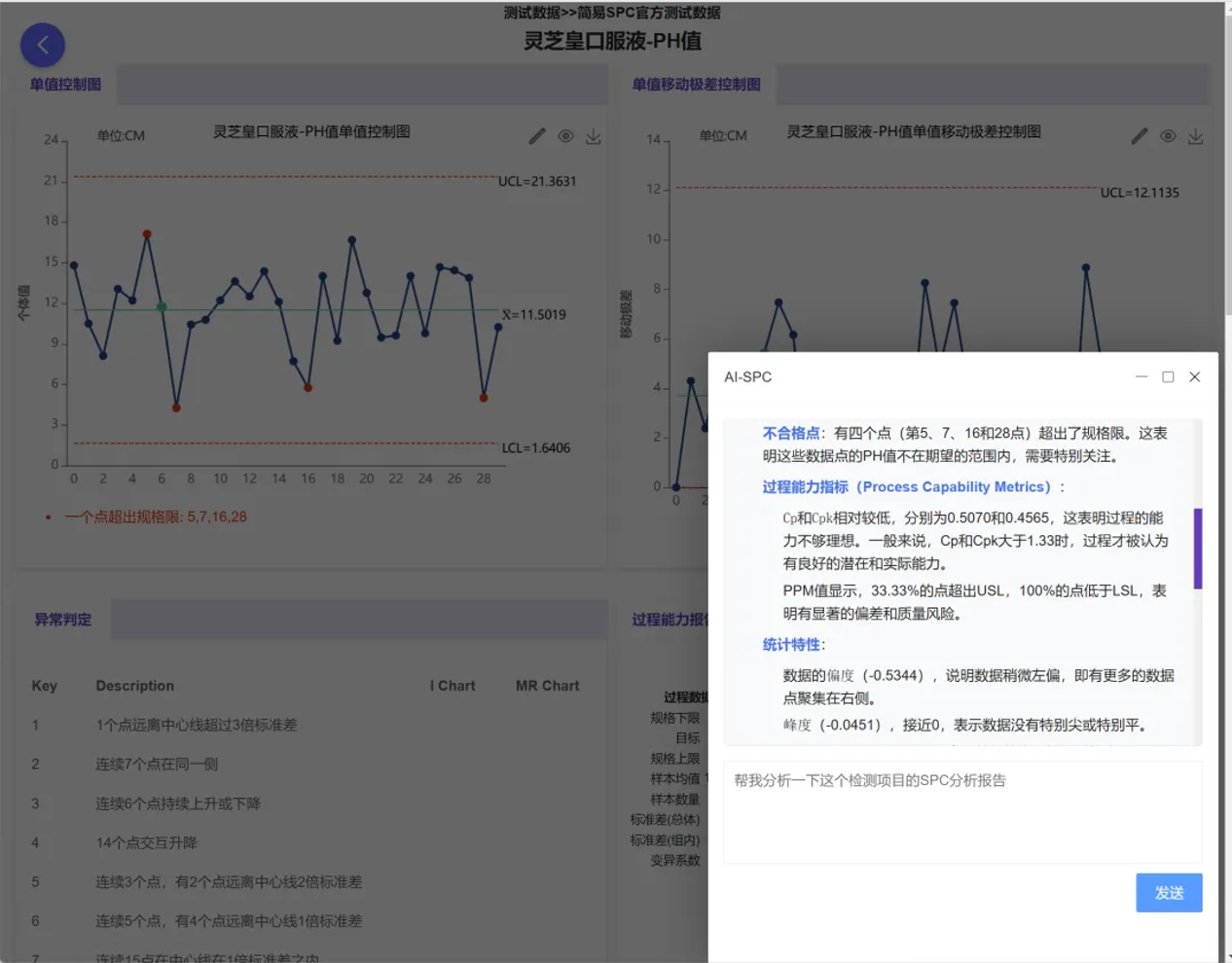
Beyond basic statistics, we've introduced more cutting-edge tools to deeply mine the value of data. The MSA (Measurement System Analysis) module covers gauge linearity and bias studies, Gage R&R studies, and more, ensuring the stability and accuracy of the gauges themselves before statistical analysis. Simultaneously, the system innovatively integrates large models such as ChatGPT and DeepSeek, enabling one-click intelligent interpretation of statistical results and assisting quality managers in quickly analyzing the causes of anomalies.
We are committed to helping enterprises build efficient digital quality systems with a lightweight architecture and extremely low technical barriers. By enabling data to "speak" and anomalies to be "detected in real time," we help China's manufacturing industry steadily move towards high-quality development.
- An In-Depth Analysis of SPC Abnormality Detection Logic
- What types of charts can be used in dashboards for subgroup-based inspection items?
- What creative uses can be made for dashboards containing single-value test data?
- What If Subgroup Sizes Are Not Fixed?
- Invisible Variations That Define Yield :Practical Applications of SPC in Semiconductor Manufacturing
- Simple SPC 4.0 – Detailed Product Overview
- Simple SPC 4.0 Official Release
- Using data to safeguard safety: Application practices of SPC in the pharmaceutical industry
- How can risks be identified in advance in automobile manufacturing? — Sharing SPC application practices
- Should Manufacturing Companies Still Implement SPC Amid Economic Downturn and Poor Business Performance?
- What should we do if the customer requires the immediate implementation of SPC process control during a factory audit?
- Simple SPC has been recognized for the third time as the "2025 SPC Statistical Process Control Software of the Year" by China SoftWare Home.
- Giving SPC AI Wings: DeepSeek Enhancing Efficiency and Depth of Quality Management
- AI-Enhanced Statistical Process Control (AI-SPC): Revolutionizing Quality Management in the Era of Smart Manufacturing
- General-Purpose Artificial Intelligence Models (DeepSeek, etc.) and Statistical Process Control (SPC): A New Era of Intelligent Quality Management
- Simple SPC 2.0 released, with upgraded functions and optimized performance
- CPK and PPK: Essential Questions in Quality Interviews, Do You Truly Understand Them?
- Unilateral or Bilateral: An In-Depth Exploration of Specification Limits and Control Limits in SPC Analysis and Their Impact on Metrics
- How to Calculate Control Limits for Xbar-R and Xbar-S Control Charts in SPC Analysis and When to Use Each Chart
- Is SPC or Another Method Better for Determining Batch Consistency with Standards? A Recommended Analysis Approach
- Beyond SPC Control Charts: Lesser-Known but Effective Quality Analysis Tools
- SPC is the most accessible, effective, and performance-demonstrating analytical tool in the manufacturing industry.
- How to Quickly Identify Hidden Correlations Between Test Items Using the SPC System?