
- Panyu District, Guangzhou, Guangdong, China
- 2044, 2nd Floor, Yayun Avenue, Dalong Street
- whatsapp:
- +86 13265357928
An In-Depth Analysis of SPC Abnormality Detection Logic
In SPC, Control Charts Are More Than Recorders — They Are Early Warning Systems for Process Stability
In Statistical Process Control (SPC), control charts are not merely tools for recording data; they serve as early warning systems for process stability.
The accuracy and flexibility of abnormality detection directly determine the effectiveness of a quality prevention system.
In Bingo’s self-developed Web-based SPC system, we integrate rigorous statistical theory with real industrial requirements, building a multi-dimensional and dynamic abnormality detection framework that enables earlier, more reliable quality risk identification.
1. Statistical Foundation: Capturing Extremely Low-Probability Events
At its core, abnormality detection is about identifying low-probability events within process data.
Under a normal distribution, the probability of a data point exceeding ±3σ (three standard deviations) is only 0.3%.
Bingo SPC fully supports the standard Nelson Rules and further extends them to 11 abnormality detection rules, covering all typical patterns—from single-point violations to non-random trends.
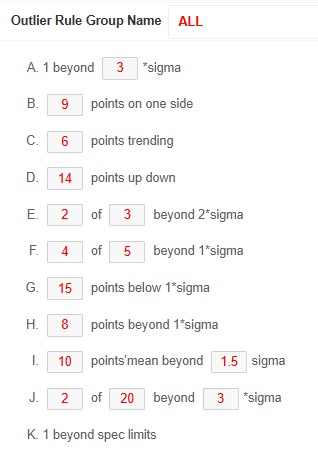
Common rules include:
Point beyond limits: One point beyond ±3σ from the center line
Shift: Nine consecutive points on the same side of the center line
Trend: Six consecutive points continuously increasing or decreasing
Alternation: Fourteen consecutive points alternating up and down
Zone rule: Two of three consecutive points beyond ±2σ on the same side
Customizable Rule Parameters
For each rule, parameters such as the number of consecutive points or sigma thresholds can be fully customized.
This flexibility allows the system to adapt to stricter or more relaxed business requirements, instead of forcing all processes to follow a single rigid standard.
2. Flexible Configuration: Three-Level Rule Group Priority Logic
Different industries—and even different processes within the same factory—have very different sensitivities to variation.
To solve the problem that “one-size-fits-all rules do not work,” the system introduces rule groups with hierarchical priority control:
System-level rules
Define the company-wide quality baseline.User-level rules
Support the analytical preferences of individual quality engineers.Inspection-item-level rules (highest priority)
Customized detection strategies for specific critical characteristics, such as key hole diameters or thickness.
This design ensures standardized quality control at the corporate level, while remaining flexible enough for highly differentiated scenarios such as chip substrate dimensions or equipment operating temperature.
3. Real-Time Response: From Data Entry to Instant Highlighting
Abnormality detection is no longer an after-the-fact activity.
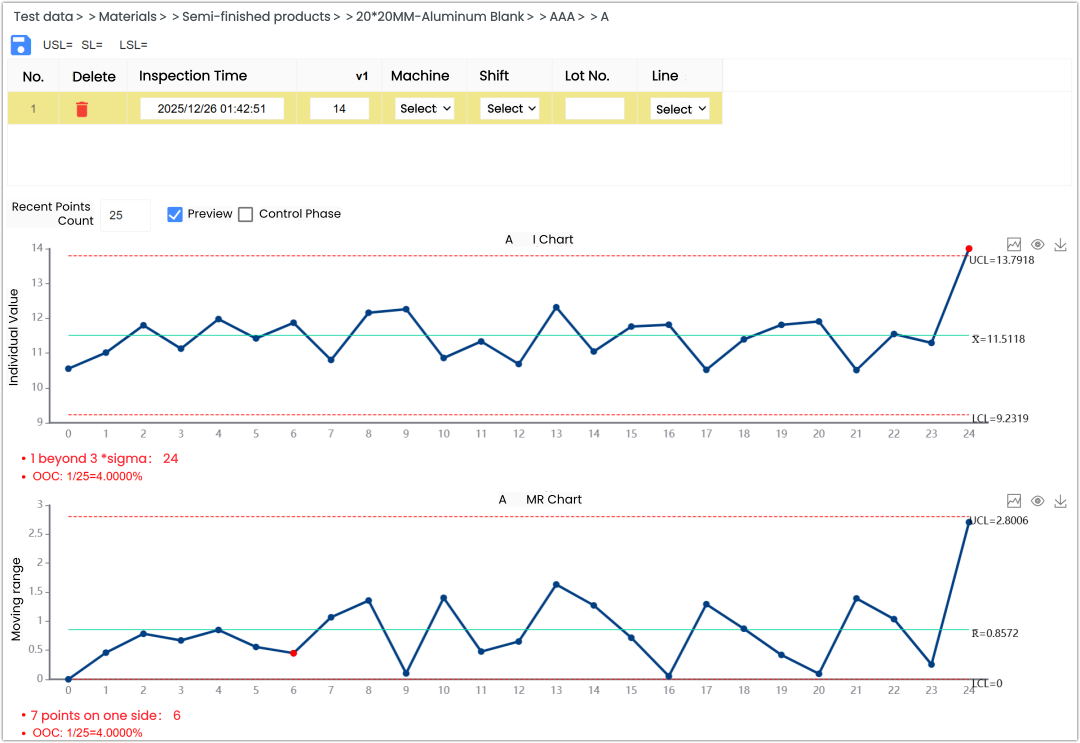
Once inspection data flows into the system—via manual entry, Excel upload, or real-time industrial protocols (TCP, MQTT, OPC, Web API, CSV)—the control chart updates dynamically without page refresh and highlights abnormal points instantly in red.
This “detect-as-you-measure” mechanism significantly shortens the time window between variation detection and corrective action, reducing the risk of defect propagation.
4. Evolution: Machine Learning and AI-Powered Interpretation
Beyond traditional statistical rules, Bingo SPC incorporates advanced technologies to enhance abnormality detection:
- Machine learning–based detection
Algorithms such as Isolation Forest and K-Means are integrated as supplements to classical SPC rules, providing higher sensitivity when analyzing complex, multi-dimensional data. - AI large-model interpretation
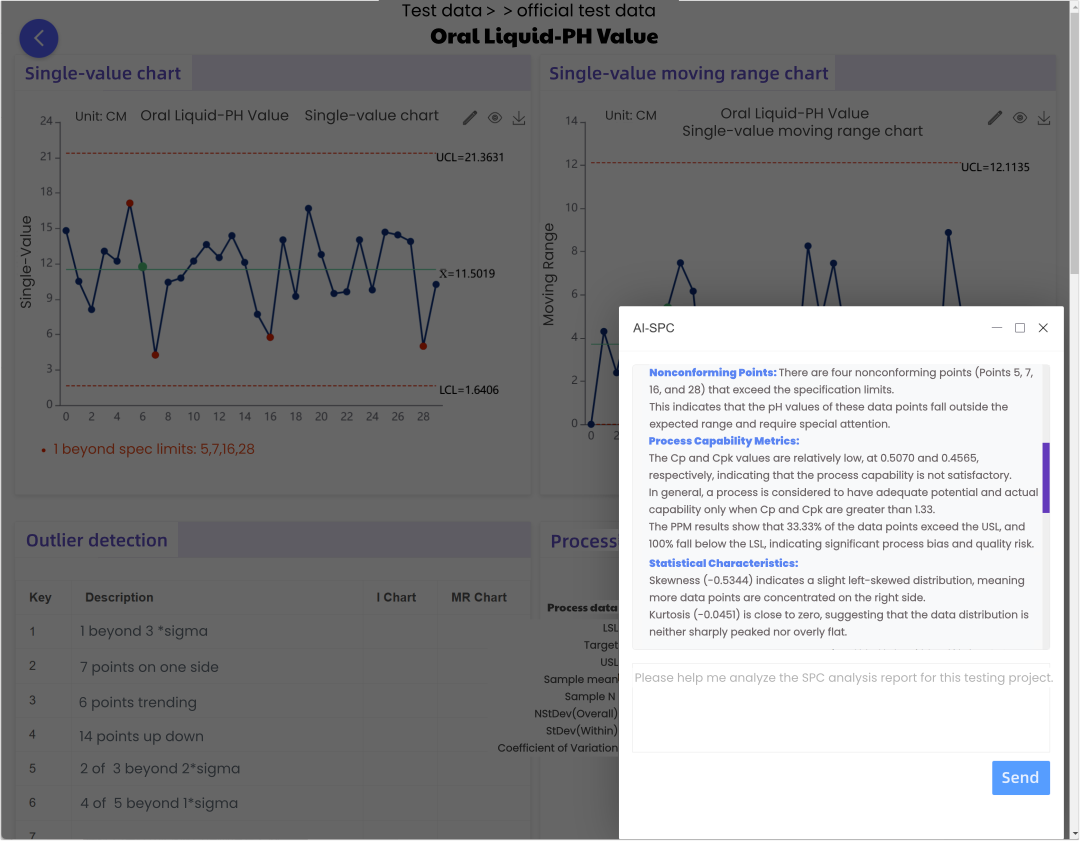
By integrating models such as ChatGPT and DeepSeek, the system can generate intelligent explanations immediately after an abnormality is detected.
With one click, quality engineers receive AI-assisted insights to quickly identify whether the issue originates from Man, Machine, Material, Method, Measurement, or Environment.
Abnormality detection rules are the core of any SPC system.
By combining standardization, customization, and intelligent interpretation, Bingo SPC enables every quality curve to “speak”—issuing warnings before defects are produced, not after.
This is how SPC moves from passive monitoring to proactive quality prevention.
- What types of charts can be used in dashboards for subgroup-based inspection items?
- What creative uses can be made for dashboards containing single-value test data?
- What If Subgroup Sizes Are Not Fixed?
- Invisible Variations That Define Yield :Practical Applications of SPC in Semiconductor Manufacturing
- Simple SPC 4.0 – Detailed Product Overview
- Simple SPC 4.0 Official Release
- Using data to safeguard safety: Application practices of SPC in the pharmaceutical industry
- How can risks be identified in advance in automobile manufacturing? — Sharing SPC application practices
- Innovative Practices and Applications of Web SPC Systems
- Should Manufacturing Companies Still Implement SPC Amid Economic Downturn and Poor Business Performance?
- What should we do if the customer requires the immediate implementation of SPC process control during a factory audit?
- Simple SPC has been recognized for the third time as the "2025 SPC Statistical Process Control Software of the Year" by China SoftWare Home.
- Giving SPC AI Wings: DeepSeek Enhancing Efficiency and Depth of Quality Management
- AI-Enhanced Statistical Process Control (AI-SPC): Revolutionizing Quality Management in the Era of Smart Manufacturing
- General-Purpose Artificial Intelligence Models (DeepSeek, etc.) and Statistical Process Control (SPC): A New Era of Intelligent Quality Management
- Simple SPC 2.0 released, with upgraded functions and optimized performance
- CPK and PPK: Essential Questions in Quality Interviews, Do You Truly Understand Them?
- Unilateral or Bilateral: An In-Depth Exploration of Specification Limits and Control Limits in SPC Analysis and Their Impact on Metrics
- How to Calculate Control Limits for Xbar-R and Xbar-S Control Charts in SPC Analysis and When to Use Each Chart
- Is SPC or Another Method Better for Determining Batch Consistency with Standards? A Recommended Analysis Approach
- Beyond SPC Control Charts: Lesser-Known but Effective Quality Analysis Tools
- SPC is the most accessible, effective, and performance-demonstrating analytical tool in the manufacturing industry.
- How to Quickly Identify Hidden Correlations Between Test Items Using the SPC System?